
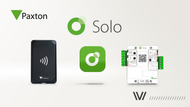
The access control landscape continues to shift towards simpler, smarter and more flexible solutions, and Paxton’s latest release, Solo, is a strong example of that direction.
From a Videcon perspective, what stands out most is how deliberately Solo strips back traditional complexity. There’s no server, no dedicated PC, and no heavy on-site infrastructure. Instead, the entire system is designed to be set up and managed through a mobile device.
As Paxton describes it, Solo is a “complete re-imagining of how networked access control is achieved,” and that sentiment is clearly reflected in its design approach.
Designed Around the Smartphone.

Solo places the smartphone at the centre of the system. It’s used for setup, management and daily operation, removing the need for traditional cards, fobs or local software platforms.
By using built-in mobile authentication such as biometrics, access becomes both more convenient and more secure while also reducing reliance on credentials that can be lost or duplicated.
For installers, this significantly simplifies deployment. Systems can be commissioned quickly, with fewer components and less dependency on customer IT environments.
Bridging the Gap Between Standalone & Network Systems.
Historically, installers have had to choose between simple standalone systems or more complex networked solutions. Solo effectively bridges that gap.
It delivers the ease of installation associated with standalone systems, while still offering the functionality expected from a connected, cloud-based platform. This includes remote management, real-time updates, and system visibility from anywhere.
For many projects, particularly small to medium-sized sites, this balance will be a key advantage.
Practical Benefits for Installers & End Users.
For installers, Solo reduces on-site time and removes a number of traditional installation barriers. There’s no server configuration or complex networking setup required, which makes it particularly attractive for fast-moving projects.

For end users, the benefits are equally clear:
- Remote access control via mobile
- Simple user management
- Reduced reliance on physical credentials
- Visibility of access events in real time
It’s a system built to reduce friction on both sides of the installation.
A Shift Towards Accessible Security.
What Solo highlights more than anything is the continued move towards accessible, scalable security systems that don’t compromise on capability. By lowering the entry point for access control, it opens opportunities across a wide range of sites, from small businesses to multi-location operators looking for consistency without complexity.
Final Thoughts.
Paxton Solo isn’t about adding more features; it’s about removing barriers.
From Videcon’s perspective, that’s what makes it a significant release. It aligns with what installers are increasingly asking for: quicker installation, simpler management and solutions that fit naturally into a mobile-first world.
As the market continues to evolve, systems like Solo point clearly point towards where access control is heading next, and why simplicity is becoming one of its most powerful features.